GTA San Andreas Multiplayer in 2026: SA-MP, open.mp, and MTA:SA
SA-MP froze a decade ago, open.mp picked it up, and MTA:SA never stopped. Here's the factual state of GTA San Andreas multiplayer in 2026 — and whether you can still play it.
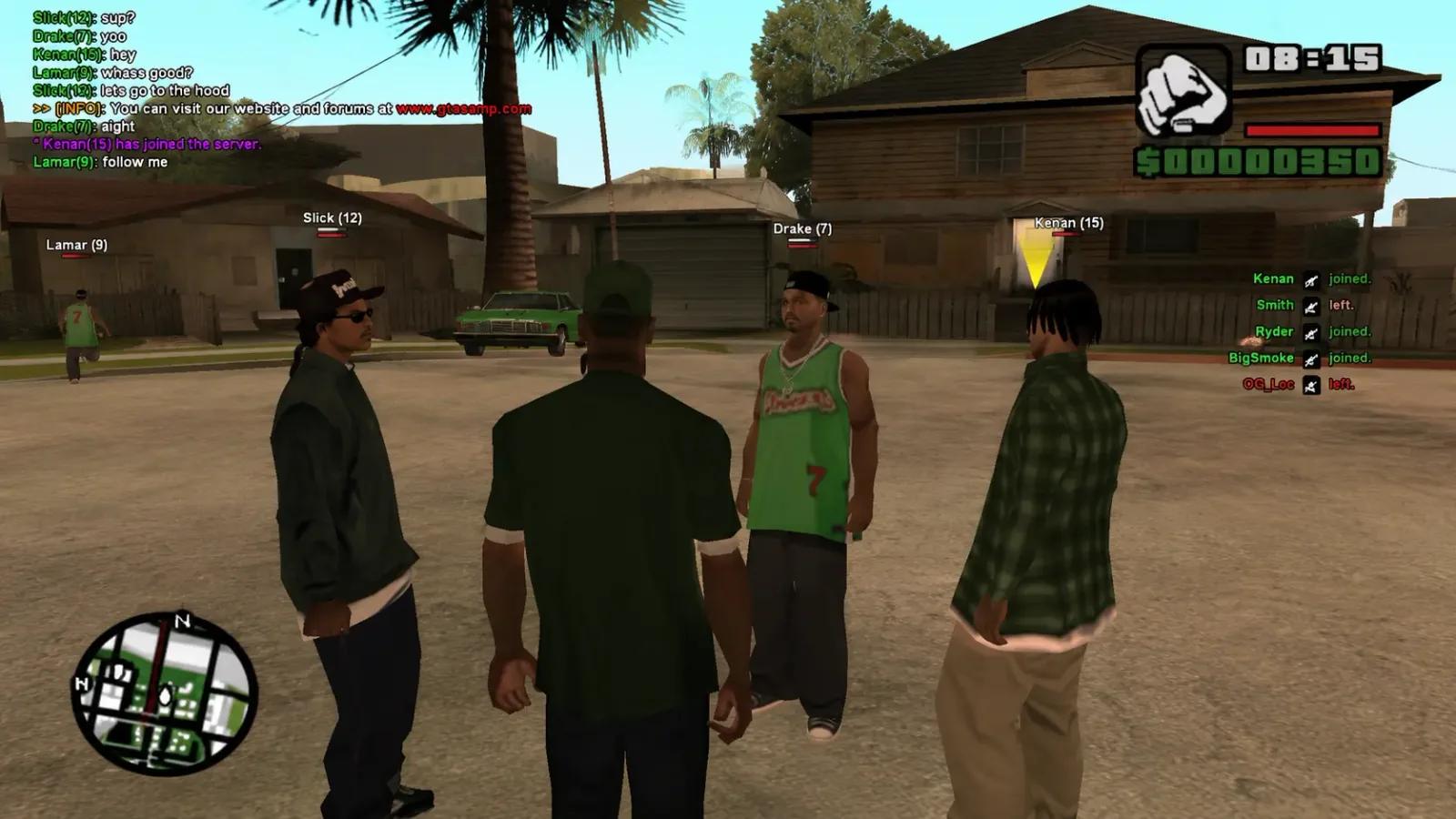
A 2004 game still has a living multiplayer scene in 2026 — smaller than its peak, but online, populated, and actively developed. The catch: "GTA San Andreas multiplayer" is not one thing. It's three, and they get conflated constantly. SA-MP is the frozen original. open.mp is the community continuation that runs SA-MP's servers. MTA:SA is a separate project that never depended on either.
Below: what each one is, where it stands in 2026, and whether you can still get in.
Where it came from
SA-MP — San Andreas Multiplayer — grew out of the mid-2000s GTA-multiplayer-mod scene, the same lineage that produced the earlier Vice City Multiplayer and GTA:Multiplayer experiments. It was built by Kalcor (Kyle Corlett) and the SA-MP team and became the dominant way to play San Andreas with other people on PC.
SA-MP's design was simple and effective: a client that hooked the original game, a server package anyone could host, and a Pawn scripting system that let server owners build whole game modes from scratch. That scripting freedom is the reason SA-MP outlived every other classic-GTA multiplayer mod — server owners built deathmatch, racing, cops-and-robbers, and the genre that came to define it, roleplay. At its mid-2010s height, SA-MP ran thousands of listed servers and a large concurrent population.
SA-MP today: frozen but still online
SA-MP's last official release is 0.3.7 (the R-series bug-fix builds, around 2015), plus the community-oriented 0.3.DL that added custom-object/skin downloading. A version 0.3.8 was announced and then canceled. Kalcor stepped back from active development years ago, and the official client has had no meaningful updates since the 0.3.7 era.
It did not die, though. As of 2026 the SA-MP master server is still operational, and server-tracker sites still list active SA-MP servers — by most third-party estimates a few hundred, the large majority of them roleplay servers. That is sharply down from the mid-2010s peak, and exact concurrent-player figures are not published anywhere reliable, so any specific number should be read as an estimate. The accurate summary: SA-MP the codebase is frozen, SA-MP the network is alive and niche.
open.mp: the community took the wheel
The stagnation is what produced open.mp (open multiplayer) — an open-source, fully backwards-compatible continuation of SA-MP. Existing SA-MP servers, Pawn gamemodes, and AMX scripts run on open.mp without modification, which is the entire point: it is a drop-in replacement that keeps the decade-plus of community server content working while fixing bugs the abandoned client never will.
The timeline is well documented on the project's own blog: a semi-public beta program opened in January 2022, a Release Candidate 1 landed in January 2023, and development has continued through 2026 with a modern launcher that includes a built-in server browser and favorites. open.mp is an independent rewrite maintained on GitHub, not a repackaging of old leaked SA-MP source. What is not publicly quantified is how much of the SA-MP server population has moved over — there is no reliable published split between "still on the original client" and "on open.mp," so treat claims of a specific share with caution. Directionally, open.mp is where the SA-MP ecosystem's active maintenance now happens.
MTA:SA: the one that never stopped
Multi Theft Auto: San Andreas (MTA:SA) is the other half of the story and the one most "SA-MP in 2026" conversations forget. It is older than SA-MP — the Multi Theft Auto project dates to 2003, starting on GTA III — and it took a very different path. MTA's source was released under the GPLv3 in November 2008, it is maintained on GitHub to this day, and it reached its 1.6 line in the 2020s.
Two architectural choices made MTA durable. It never depended on the SA-MP master server, so SA-MP's stagnation never touched it. And it uses its own Lua scripting engine and map/resource system rather than Pawn, which built a separate community oriented more toward racing, freeroam, and made-from-scratch content than SA-MP's roleplay monoculture. MTA:SA's active population in 2026 is, by community estimates, in the low thousands of players — again, an estimate, not an audited figure — concentrated on a smaller set of long-running servers.
The catch: you need the original 1.0
Every one of these requires the same thing: the original PC build of GTA San Andreas (the v1.0 executable). None of them work with the GTA: The Trilogy – Definitive Edition (2021), which is a different engine entirely and cannot run SA-MP, open.mp, or MTA.
That is a real structural constraint, because in October 2021 Rockstar delisted the original GTA III, Vice City, and San Andreas from Steam and other digital stores ahead of the Definitive Edition launch, and the temporary offer to reinstall the originals for prior owners ended in mid-2022. Players who owned the original on Steam or the Rockstar launcher before delisting keep access to it. New players cannot buy the original 1.0 through official channels and rely on community downgrade patches applied to other versions. The scene's long-term ceiling is set less by interest than by how hard the original game is to legally obtain.
Where Rockstar stands
There is no official Rockstar relationship with SA-MP, open.mp, or MTA:SA. The historical pattern with classic-GTA multiplayer mods has been quiet tolerance as long as projects stay non-commercial and don't ship Rockstar's copyrighted game files — alongside aggressive DMCA action whenever code or assets look like they cross that line.
That tension is still live. In early December 2025, Take-Two issued a DMCA takedown against MTA:SA's GitHub repository; the MTA team filed a counter-notice and the repository was restored after Take-Two did not follow through with litigation, as reported by TorrentFreak. It's a useful reminder that "tolerated" is not the same as "sanctioned."
This is also where the FiveM comparison matters and gets misread. Rockstar's 2023 acquisition of Cfx.re, the team behind FiveM and RedM, sanctioned roleplay servers for GTA V and Red Dead Redemption 2 — not for the classic titles. FiveM (created by a separate developer, unrelated to Kalcor's SA-MP or the MTA project) is also where the gravity of new GTA roleplay has sat since roughly 2017. For the modern, officially-owned side of that story, see Rockstar owns FiveM now and the broader GTA Online modding controversy history. The classic SA scene runs in parallel to all of it, unsanctioned and self-sustaining.
Can you still play it in 2026?
Yes. The practical path:
- Get a working copy of the original GTA San Andreas PC (v1.0) — straightforward if you owned it before the 2021 delisting, more involved if you didn't.
- Install open.mp (recommended over the frozen original SA-MP client for new setups, since servers and scripts are compatible either way) or MTA:SA if you want the racing/freeroam/content side.
- Pick a server from the in-client browser. Expect a roleplay-dominant list on the SA-MP/open.mp side and a smaller, content-driven set on MTA.
The scene is a fraction of its peak and the population numbers floating around are estimates rather than measured figures — that's the honest caveat. But two decades on, San Andreas multiplayer is not a "lost era" the way GTA IV's multiplayer is. It's frozen in one place, carried forward in another, and quietly maintained in a third. For the enforcement backdrop that shapes its limits, see GTA Online cheating and anti-cheat history; for the single-player game itself, the San Andreas 100% completion checklist and territory war mechanics hold up just as well in 2026.